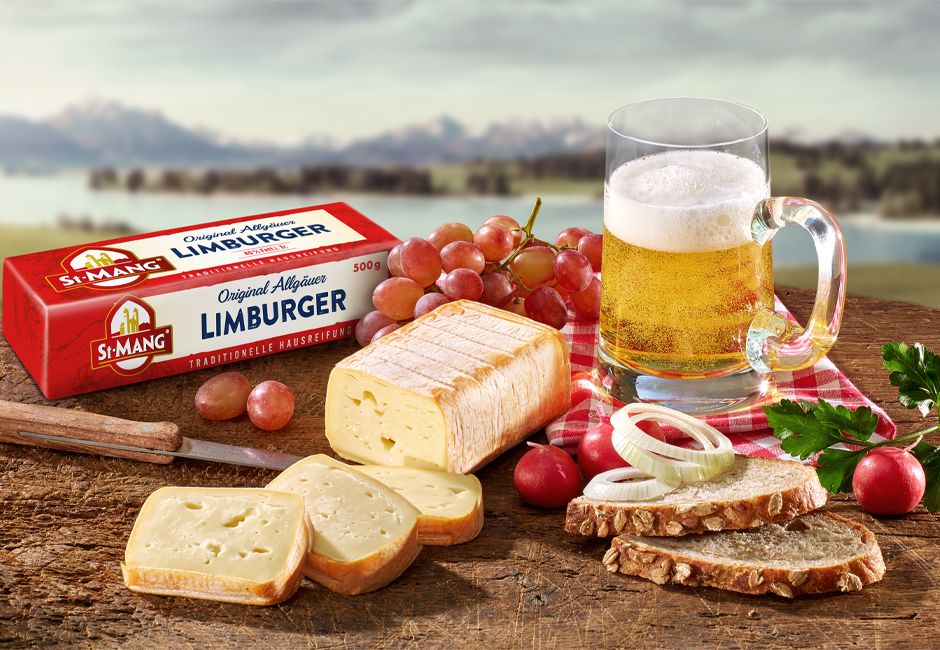
The most famous smelly cheese in the world is a Bavarian immigrant. Limburger was born in the Duchy of Limburg — the Herve area of what is now Belgium, where the Herve variant still holds its own Belgian PDO — and was adopted by Allgäu cheesemakers in the 19th century, who made it their own. A related brick-shaped German cheese is sometimes called Backsteiner — “little brick” — for the small brick formats.
The story
Limburger is a smear-ripened brick: washed during aging with brine carrying Brevibacterium linens, the same bacteria behind human foot odor — which explains everything about the aroma and nothing about the taste. Allgäu dairies took up the style in the 1800s and never put it down; it became a workingman’s staple, the center of the traditional Bavarian cheese plate.
What it tastes like
Here is the great Limburger surprise: the smell outruns the taste by a mile. Powerfully pungent aroma, yes — but the paste is mild, creamy, buttery, genuinely gentle. Texture tells you the age: young Limburger is crumbly, almost feta-like; ripe Limburger goes Brie-soft and yielding. If the smell scares you, you’re smelling the rind’s work, not the cheese’s soul.
Flavor profile: aroma very high · taste intensity low-medium · creaminess medium-high · salt medium
Aging: ~2–3 months · Texture: young = crumbly; ripe = soft and yielding
How to serve it
The traditional plate, no improvisation needed: thick slices on pumpernickel or rye with raw onion rings and mustard. Room temperature. This is peasant food elevated by confidence — serve it like you mean it.
Drink with it: A cold Dunkel — the classic workingman’s pairing; malty sweetness settles the intensity. For wine, go off-dry: a Riesling Spätlese or Auslese “mellows out” the bite, or try a Grüner Veltliner.
Finding it in America
Imported Allgäuer Limburger reaches the US through German specialty importers — Columbia Cheese distributes an imported Allgäuer Limburger, for example. Wisconsin makes its own Limburger too: Chalet Cheese Cooperative in Monroe — founded 1885, the sole remaining US producer — makes it domestically. The domestic version is the accessible way in, though the Bavarian original is the pilgrimage.
Related: Weißlacker · Romadur · What to drink with washed-rind cheese · Meet the maker: Champignon Hofmeister