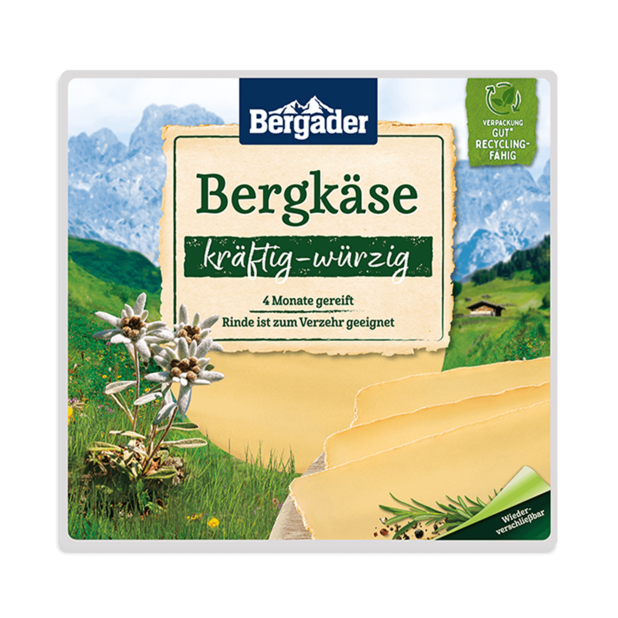
Call it Emmentaler’s baby brother, but the family resemblance hides a different life. Allgäuer Bergkäse is born high and raised low: made in the Allgäu Alps during the spring months, then carried down to valley cellars to finish ripening. That two-altitude childhood is the whole idea — mountain milk, patient cellaring — and it’s protected by European law.
The story
Bergkäse means “mountain cheese,” and the PDO (1997) means the name actually means something: only cheese from the defined Allgäu zone — the Allgäu region of Bavaria and Baden-Württemberg — made the traditional way, may bear it. The milk is raw cow’s milk, often Heumilch: silage-free hay milk from cows fed on grass and hay, never fermented feed. It’s the ingredient behind the region’s entire cheese identity, and Bergkäse is its flagship expression.
What it tastes like
Firm, smooth, golden-yellow paste. Young wheels (around 4 months, the minimum) are mild, aromatic, and nutty — the friendly face. Give it time — wheels commonly age 4 to 16 months — and it turns stronger, spicier, more insistent. An aged Bergkäse has real authority.
Flavor profile: intensity medium (young) → high (aged) · nuttiness high · salt medium
Aging: minimum 4 months, commonly 4–16 · Texture: firm, smooth
How to serve it
Two moves, both Bavarian: shave it over warm Käsespätzle, where it melts into the noodles’ eggy richness — or serve it in chunks, at room temperature, with a malty Doppelbock. The beer’s caramel and roast notes meet the cheese’s nutty spice halfway.
Drink with it: A Doppelbock or Bock — the beer’s caramel and roast notes meet the cheese’s nutty spice halfway. For wine, try an oaked Chardonnay or a Gewürztraminer.
Finding it in America
This is the gap in the market. No national-chain US retail for PDO Allgäuer Bergkäse could be verified — American Emmentaler shelves belong to the Swiss. Your path: German/European specialty importers, serious cheese shops, and the magic words “PDO Allgäuer Bergkäse” said to a cheesemonger who likes a challenge. Aged wheels travel well — if you visit the Allgäu, bring one home. Commercially packaged hard aged cheese is generally admissible for personal use, but declare every food item and check current USDA/CBP rules before travel.
The seal
PDO since 1997 — the guarantee of Allgäu origin and traditional method. What the PDO seal actually guarantees →
Related: Allgäuer Emmentaler · What is Heumilch? · The Allgäuer Käsestraße